


The boundary between public and private life has become increasingly blurred – or, in fact, completely eroded. From the hyper-fixation on the private affairs of government officials and royals to the expansion of laws affecting our most personal relationships in the home, have we have seen the death of private life?
Concerns around privacy are often related to the power of tech-giants and social media, gaining and selling personal data. Many of the concerns over TikTok were originally rooted in the company’s selling of data to China. Now the Irish government is preparing to roll out comprehensive digital wallets for its citizens that ‘have digital versions of their birth cert, driving license, European health card, and other official documents’. These digital wallets are stored on their phones and used for age verification. With this, concern around government access to private data is growing, and free-speech advocates are pushing back on the ability of the state to track both public and private comments online.
But privacy has a much deeper meaning and higher value than online data. The ability to separate our public and private lives has historically been fundamental to the development of the self and intimacy. Privacy allows us to have a guarded space to openly air opinions and make mistakes, without the social judgement of wider society. This enables us to clarify our thoughts before putting them in the public realm, allowing us to be guided by our own consciences in public life.
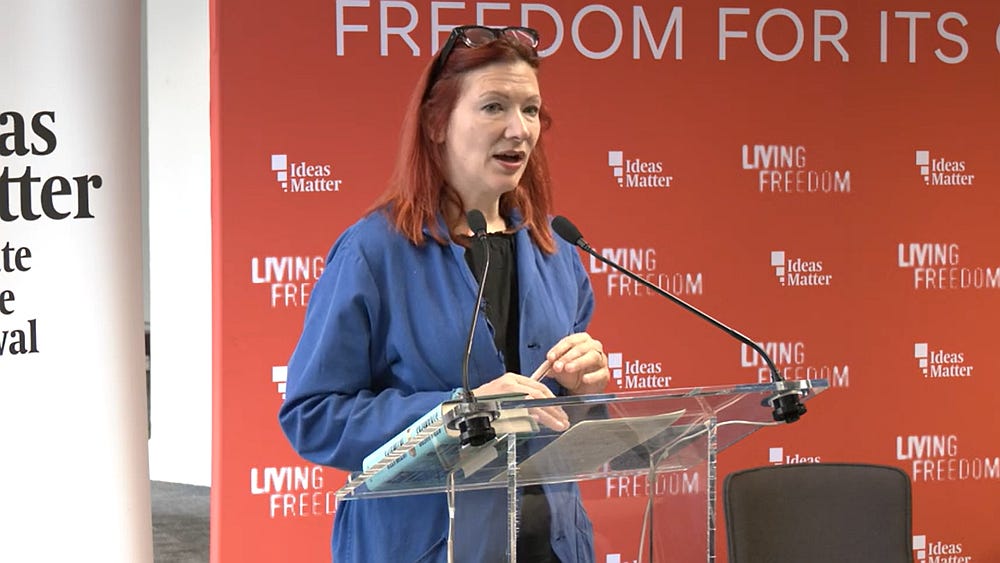
Tiffany Jenkins argues that the establishment of privacy was foundational to the development of individual conscience and public autonomy. She explains that privacy is a protean concept, which shifts depending on its historical and cultural context. The origins of modern privacy can be traced as a consequence of the Reformation - when it was decreed that individuals were free to worship how they wish in private. The curation of an individual relationship with God led to open private reflection on dictated morals and social norms, and the ability for the self to decipher what was right or wrong.
In her lecture and her book, Strangers and Intimates, Tiffany highlights how the erosion of the private sphere has redefined the relationship between civil society and the state. Yet, the protected spheres, away from the tentacles of public institutions, are quickly eroding, as regulation by technocrats and law has attempted to manage relationships between individuals. Perhaps, most notably, this has expanded into the relationship between parents and children, as the politicised teachings of well-being and gender have weakened the authority of parents within the family home.
Culturally, the value of privacy has been hijacked; it is now seen as something only needed for those who are up to no good. But as social norms and collective values are weakening, it is increasingly difficult to come to collective consensus on the line between right and wrong. And as social norms have collapsed, we have become dependent on legal frameworks to manage behaviour, because we no longer trust our judgement. Yet, by sacrificing our privacy, are we surrendering our ability to develop our individual autonomy and decide matters of individual conscience for ourselves?
Watch Tiffany’s lecture from Living Freedom 2025 here:
Hopefully, you’ll be inspired to apply for this year’s summer school! Find out more about the event and how to apply on our Summer School 2026 page.